Octopuses & Their Unique Biology
Learn about one of the most intelligent marine creatures
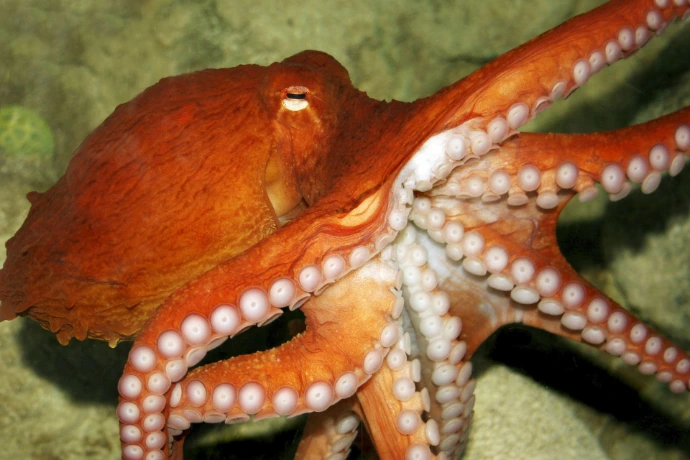
Octopuses are mollusks found in every ocean in the world. They live in coastal waters and often stay inside small holes and crevices in rocks. Due to their unique physiology and intelligence, they’re often called alien-like.
Octopus Physiology
Octopuses are named for their distinctive eight arms that are merged with their head. They’re mostly made up of muscle, but they have beaks made up of chitin (the same material that makes up insects’ exoskeletons). These beaks are used to crush and eat their prey. Octopuses have three hearts. Two are used to pump blood to their gills and one for the rest of their body. They also have nine brains, with eight in each of their arms and one in their head. They have copper-based blood, like our beloved horseshoe crabs, which is more efficient for transporting oxygen in cold conditions. They are able to change color and camouflage because of their special cells called chromatophores and changing the texture of their skin. They do this by controlling the size of their papillae (similar to the bumps on your tongue) and by opening and closing pigment sacs in their skin.
Octopus mental abilities
Octopuses display many mental abilities that include problem solving skills and tool use, and complex memory. Studies have shown that octopuses can navigate mazes, unscrew jar lids, and make use of objects such as coconut shells as portable shelters for protection. Their impressive cognitive abilities are linked to their nervous system, in which a significant number of neurons spread out throughout their arms. This allows for both centralized and independent arm control. Also, octopuses can store long term memories, modify their behavior according to different situations, and even engage in observational learning.
Octopuses are known to have very high intelligence and can solve complex puzzles to get food rewards. They manipulate objects, remove barriers, and learn through trial and error to reach their goals. They can also learn to find their way through mazes and remember successful routes. In experiments, it was observed that they can open closed jars to reach the prey inside. They learn the correct twisting direction and can repeat it later again, showing memory and understanding.
In addition to these skills octopuses can solve problems in their natural environments, such as escaping traps or finding shelter. They use their flexible tiny bodies to squeeze through tiny openings and can quickly figure out how to get out of enclosures. Some species even use objects like coconut shells or rocks as tools for protection or to build shelters. These abilities show that octopuses do not rely only on instinct, but also on thinking, learning, and creativity to solve problems.
sources:
Gilmore, R., Crook, R. & Krans, J. L. (2016) Cephalopod Camouflage: Cells and Organs of the Skin. Nature Education 9(2):1
https://www.nhm.ac.uk/discover/octopuses-keep-surprising-us-here-are-eight-examples-how.html
https://ocean.si.edu/ocean-life/invertebrates/how-octopuses-and-squids-change-color
https://www.nwf.org/Educational-Resources/Wildlife-Guide/Invertebrates/Octopuses
https://www.nhm.ac.uk/discover/octopuses-keep-surprising-us-here-are-eight-examples-how.html